
Pt. 4 – make people disappear
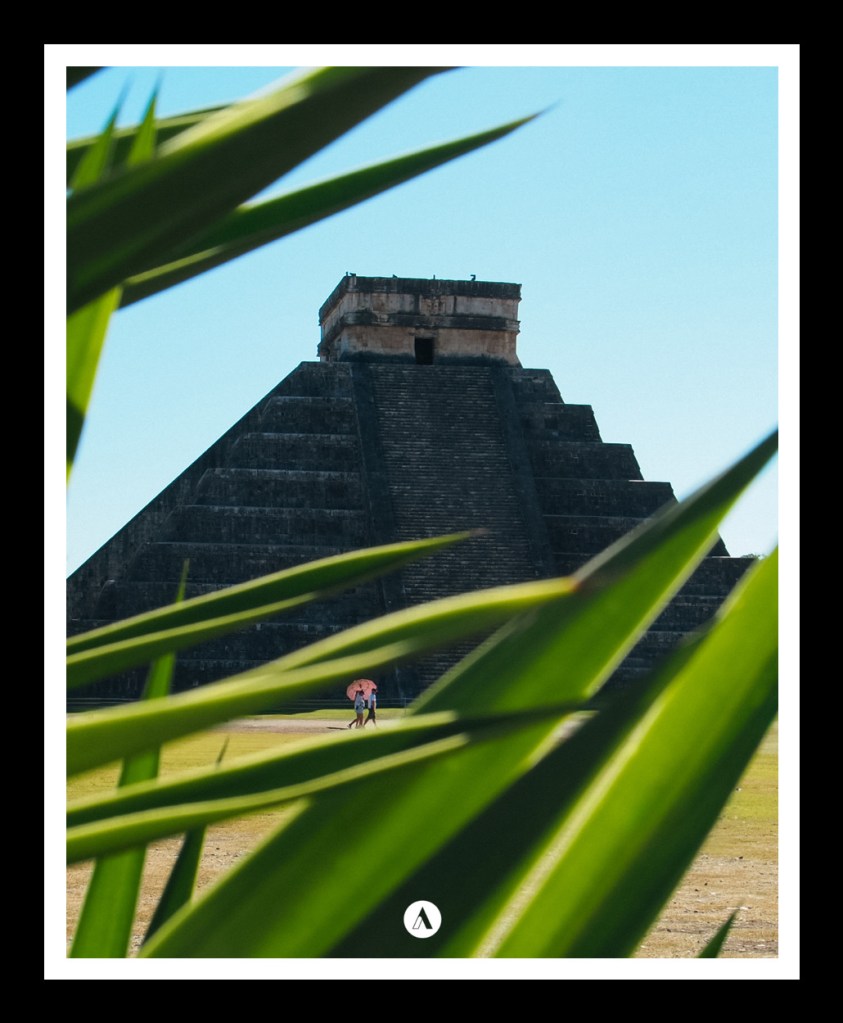
Auf meiner Mexiko-Reise musste ich natürlich Chichén Itzá besuchen, eines der sieben Weltwunder der Neuzeit. Früh aufstehen war angesagt, aber als wir angekommen sind, waren die Schlangen an den Kassen schon so lange, dass ich es mir kaum vorstellen wollte, wie voll es über den Tag werden könnte.
Die Pyramiden selbst sind abgesperrt und so konnte man zumindest Fotos ohne Menschen machen, die mir aber zu gewöhnlich und zu langweilig waren.
Ich suche mir dann in solchen Situationen Pflanzen, andere Gebäude oder Gegenstände, um die Besucher dahinter zu verstecken. Oder wie hier im Bild sehr ausgewählt zu fotografieren. Ebenso lässt sich in so einer Komposition gut mit der Schärfentiefe spielen, sodass die Blätter unscharf sind, während die Pyramide scharf im Hintergrund ist.
Da Blumenbeete oft sehr viel niedriger bepflanzt sind, als wir für gewöhnlich fotografieren würden, müssen wir also in die Hocke gehen, um die Personen auszublenden. Es ist wichtig, auch hier die Kamera möglichst gerade zu halten, um die Linien der Gebäude nicht kippen zu lassen. Zudem musste ich zugunsten der Bild-Komposition akzeptieren, dass die linke Seite der Pyramide dunkler und ist und die Struktur und Form einer Seite weniger gut sichtbar ist.
Dennoch ist das Foto für mich eines der interessantesten während des Besuches der alten Ruinen.
On my trip to Mexico, I had to visit Chichén Itzá – one of the New Seven Wonders of the World. Getting up early was a must, but when we arrived, the lines at the ticket counters were already so long that I could barely imagine how crowded it would get as the day went on.
The pyramids themselves were not accessible, so I was at least able to take photos without any people – though I found them too ordinary and too boring.
In situations like these, I look for plants, other buildings, or objects to hide the visitors behind—or, as shown here in the image, I compose the shot very selectively when adding people. Likewise, this type of composition is suitable to play with depth of field, allowing the leaves to appear blurred while the pyramid remains sharp in the background.
Since flowerbeds are often planted much lower than the height at which we typically take photographs, we must crouch down in order to keep people out of the frame. Here, too, it is important to hold the camera as straight as possible to prevent the lines of the buildings from appearing tilted. Furthermore, for the sake of the composition, I had to accept that the left side of the pyramid would appear darker, making the structure and form of that side less clearly visible.
Nevertheless, for me, this photo is one of the most interesting taken during the visit to the ancient ruins.

 www.khun-aleks.de